


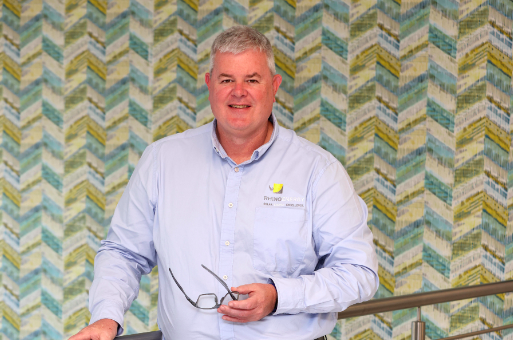
Rogan Davies, Group CEO of Rhino Energy Solutions (RES), a national solar EPC+M company, joined a panel alongside development partner Nav.Energy, First National Bank’s alternative energy solutions platform, at Solar & Storage Live Cape Town this week. The discussion explored what changes when a financial institution helps shape a solar project from the very first conversation with the customer.
According to RES most commercial solar projects in South Africa are still financed in the same order. A business chooses a system, usually on the advice of whichever installer reached it first and then goes to a bank to pay for it. By the time a lender sees the proposal, the system size, the technology and often the contract model have already been decided.
RES believes that sequence costs clients’ money, particularly agricultural and industrial businesses whose energy needs are spread across a large site.
“By the time the bank sees the deal, the most important decisions have already been made, often by whoever got to the customer first,” says Rogan Davies, Group CEO of Rhino Energy Holdings. “The farmer is left to stitch together the advice, the engineering, the contract and the funding, and carry the risk of the gaps between them.”
A farm with 22 electricity accounts
The project at the centre of the panel discussion is a citrus farm that was running on 22 separate Eskom supply points. Irrigation pumps, boreholes, the packhouse, cold storage and staff housing were each billed on their own, and each carried fixed and network charges regardless of how much power it drew. Tariffs have climbed faster than inflation for years, and on a farm an outage interrupts irrigation scheduling and the cold chain as well as showing up on the bill. “Energy had moved from an overhead to a risk to the crop,” says Davies.
The farmer never asked for solar. They wanted an energy cost they could budget for and reliable power for pumping and cold storage, and they wanted to get there without pulling capital out of the orchards.
Designing for the whole farm
RES is an existing development partner of Nav.Energy. This association provides peace of mind to the farmer knowing immediately that they are dealing with a reputable solar provider in conjunction with their finance partner. Davies says that this ecosystem is important and clients need to look to these types of partnerships when considering a solar investment. RES began with the bills and interval data for all 22 connections, then mapped where each load sits and when it runs: pumps overnight in summer, the packhouse and cold rooms in season, housing in the evenings. Put side by side, the 22 accounts turned out to describe a single farm-wide load profile that was being billed 22 times.
A rooftop system on the packhouse would have cut one bill and left 21 connections, with all their fixed charges, as they were. RES designed and Nav.Energy funded a private mini grid made up of a 3 MWp solar PV plant, 6.6 MWh of battery storage and about 22 km of overhead lines that bring every load onto one network. The storage is sized so that solar generated during the day can run the evening and overnight pumping.
The rollout is phased. Phase 1 allows the farmer to cancel 20 of the 22 Eskom supply points, and Phase 2 removes the last two once the system has a track record on site.
Where the financial institution comes in
A mini-grid of this scale is a multi-million-rand asset, and a farm’s balance sheet is already carrying land, water rights and orchards. RES has seen plenty of sound agricultural energy projects stall at this point, with a workable design and no realistic way to pay for it.
Here, Nav.Energy supplies the funding under a power purchase agreement (PPA), and RES is an equity partner in the project. The farmer has no capital outlay and buys electricity at a tariff below what they pay today. Because Nav.Energy was involved while the design was still being worked out, the finance could be structured around what the client needed.
The co-investment has a practical benefit for the client. RES engineers, procures, builds and maintains the plant, with its own O&M team monitoring performance. As an equity partner it earns its return only if the system delivers over the life of the PPA. The farmer pays only for the energy they receive.
“In this project the funder and the EPC+M partner are both invested in the same PPA,” Davies says. “When the incentives line up like that, the customer doesn’t have to referee between providers.”
What businesses should expect from a modern lender
RES says that a financial institution working in energy should ask about the client’s business before it asks about the balance sheet. On the citrus farm, the questions that shaped the deal included:
- Which loads can never go down, and which can wait an hour?
- Where is there land for a plant, and where do servitudes and access roads run?
- How will the farm grow over the next ten to twenty years?
- How long does the owner plan to farm this land? That answer sets the contract term.
A good institution also leaves the commercial model open. This farmer could have bought the plant, financed it, or bought the power. A PPA suited a business that wanted its capital working in production and preferred the funder and the contractor to carry performance risk. A neighbouring farm with a different strategy might reasonably choose to own its system, and the advice should allow for that.
“The best projects we build are the ones where the funder, the engineer and the client are in the room before anyone has chosen a product,” says Davies.
About Rhino Energy Solutions
Rhino Energy Solutions is a South African renewable energy EPC+M (Engineering, Procurement, Construction and Maintenance) company with a 19-year track record of delivering solar and battery energy storage systems across the industrial, commercial, agricultural and mining sectors. With a portfolio spanning 87 MWp of installed capacity and clients including blue-chip organisations across Southern Africa, Rhino Energy designs, builds and maintains large-format energy solutions that reduce costs, improve operational resilience and support ESG objectives. For more information, visit rhinoenergy.co.za.


