


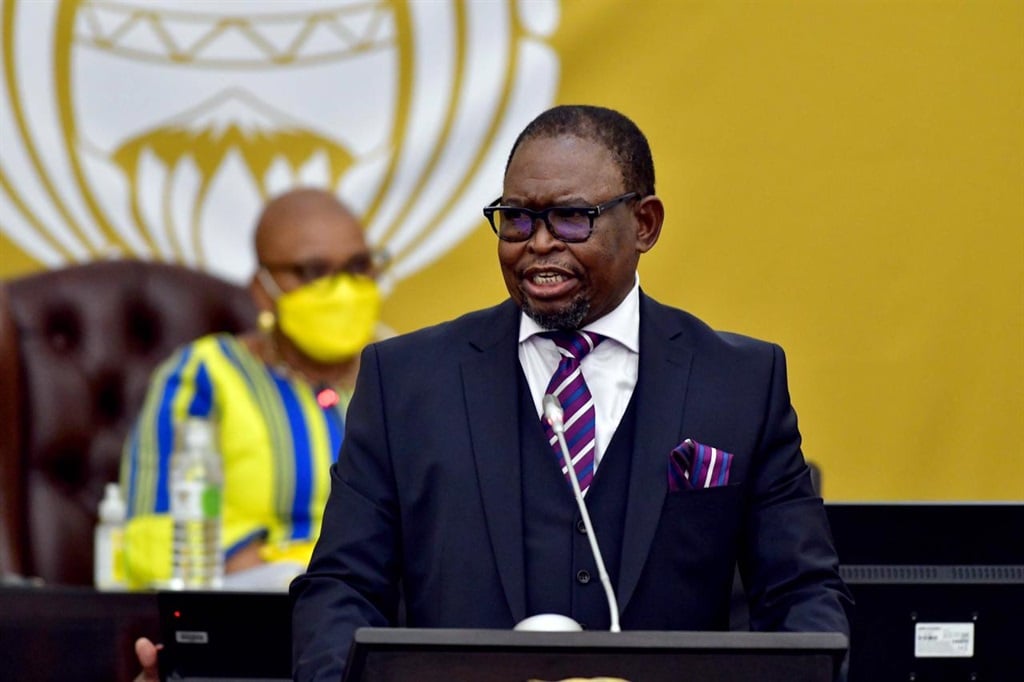
South Africa’s government finances are turning the tide, Finance Minister Enoch Godongwana said on Wednesday.
His maiden budget gave a glimpse of light at the end of a grim fiscal tunnel – with some caveats.
In a media briefing before he delivered his speech, Godongwana admitted to being “a bit scared” when he took the position as finance minister in August, given South Africa’s serious debt situation.
But on Wednesday, he said that “feels more relaxed” and that the fiscus was turning the tide.
“I’m not as panicky as I was.”
Still, he warned that government debt was dangerous: it has reached R4.3 trillion and is projected to rise to R5.4 trillion over the medium term. On average, 20 cents of every rand collected in government revenue is now being spent on debt repayments, which is crowding out spending on health and basic education.
But the good news was that tax revenue collected for the past year was R182 billion more than budgeted, thanks in part to stronger-than-expected personal income tax collections and VAT – but mostly due to mining companies that benefitted from a boom in commodity prices.
Godongwana said that at least R57 billion of the extra income had already been spent, mostly on assistance to businesses and the South African Special Risk Insurance Association (Sasria) following the civil unrest last year, and he also warned that South Africa can’t count on the mining windfall for much longer.
“The improved revenue performance is not a reflection of an improvement in the capacity of our economy. As such, we cannot plan permanent expenditure on the basis of short-term increases in commodity prices.” Treasury also warned that the mining recovery is moderating, and production is likely to be hit by high input costs, electricity shortages, inadequate rail availability and regulatory uncertainty.
Still, the 2021 tax boon has changed South Africa’s debt trajectory.
Part of the extra revenue will go towards stabilising its debt position. This means that for the first time since 2015, South Africa will reduce its borrowings. This year, it will borrow R135.8 billion less than planned.
This will help to stabilise its debt ratio at 75.1% of GDP by 2024/25 – three percentage points lower than previously projected. The consolidated budget deficit is also now expected to narrow from 6% of GDP in 2022/23 to 4.2% of GDP in 2024/25.
Government now expects to achieve a primary surplus – where revenue exceeds non-interest expenditure – by 2023/24.
“This will bring the period of fiscal consolidation to a close, creating space to reconsider the funding of South Africa’s priorities in a fiscally stable environment,” Treasury said.
For now, however, government is continuing to curb its spending growth at a below-inflation rate of 3.2% for the next three years – with strict restrictions on civil servant wages, in particular.
Tax reprieve
This year’s budget brought some welcome news, with the corporate income tax cut from 28% to 27%. Personal income tax brackets have also been adjusted to bring relief.
For the first time since 1990, there will be no hike in the fuel or Road Accident Fund levy.
Hikes in excise duties on alcohol and tobacco were kept in line with inflation (between 4.5% and 6.5%) – from above 8% last year.
From 1 March, the employment tax incentive will also increase from R1 000 to a maximum of R1 500 per month in the first 12 months and from R500 to a maximum of R750 in the second 12 months.
After collecting R1.55 trillion in tax last year, South Africa’s tax-to-GDP rate of 24.7 per cent exceeds previous highs reached in 2007/08 and 2019/20.
Click here to read more.
Source: Fin24


Leave a Reply