


When planning a new digital product, one of the first major decisions is whether to build a web app or a mobile app as the initial release. While both have clear strengths, the choice can significantly impact your speed to market, overall development cost, and ability to validate your idea early on.
Across the tech industry, there is a growing trend of companies launching with a web app first, then expanding into mobile once they have proven traction and understand their users more deeply. This approach can offer a strong foundation for sustainable growth, especially for early stage products.
This article explores why many teams take this route, when a mobile app is the better choice from day one, and what considerations should shape your decision.
The Advantages of Starting With a Web App
1. Faster to Develop and Launch Web apps are typically quicker to build because they do not require separate development for iOS and Android. The technology stack is usually less complex, the development cycles are shorter, and the deployment process is more straightforward.
For products that need to reach the market quickly or operate within limited budgets, this advantage is often a decisive factor.
2. No App Store Approvals or Submission Delays
Mobile apps require approval from Apple’s App Store and Google Play before they can be published or updated. These reviews can range from a few hours to several days and may introduce delays every time you need to release an improvement or fix a bug.
Web apps can be deployed instantly, which is valuable when rapid iteration and responsiveness are important.
3. Better for Validating Product Market Fit
A web based release gives companies more flexibility to experiment, refine features, and collect feedback without the overhead of mobile development. At this stage, the objective is to learn quickly, not to perfect the entire product experience. This makes the web a practical first step for most early versions.
When a Mobile App Is the Better First Choice
Although web apps are often the ideal starting point, there are clear situations where mobile is the correct strategic decision.
1. When Your Users Expect a Mobile App
In some sectors, users naturally expect a mobile experience. For example, consumer products in fitness, social networking, on demand services, or location based tools often compete in markets where mobile is dominant. Launching with only a web app may feel out of touch with common user behaviour in these industries.
2. When You Require Device Level Features
Some products depend on phone hardware or low level integrations that browsers cannot support. Examples include:
Bluetooth or NFC
Advanced GPS tracking
Background processing
Camera features requiring deeper control
Accelerometer or gyroscope data
If these are essential to your core functionality, a mobile app becomes the necessary starting point.
3. When Third Party SDKs Are Mobile Only
Certain integrations, especially in payments, media, or device specific workflows, are designed exclusively for mobile development. If your product relies on these SDKs, a mobile app is the more viable approach.
What Many Teams Do Not Anticipate About Mobile Development
Building a mobile app comes with additional considerations that can influence both timeline and budget.
1. Mobile Apps Require an API Layer
A mobile app cannot directly connect to a database or backend. It needs an API layer that handles communication between the app and the server. This adds an extra technical component that must be planned and developed.
2. App Stores Take a Percentage of In App Purchases
If your product uses in-app purchases or subscription payments processed through the app stores, Apple and Google may deduct a percentage, which affects your revenue model.
3. Push Notifications Are Strong on Mobile but Limited on the Web
Mobile push notifications are reliable and one of the most effective ways to re-engage users. Web push notifications exist, but they are more limited, less consistent across devices, and not supported equally by all browsers.
4. Mobile Apps Are Convenient but Require a Higher Investment
Mobile apps live on the user’s home screen and offer quick access, but this convenience comes with larger upfront and ongoing development considerations. For teams that need to release fast or prove their concept, the investment may not always align with early stage priorities.
Industry Examples That Illustrate These Decisions
Example 1: Expanding Into Mobile After Validating on the Web
A growing tech company in the service based industry launched with a web app to test user engagement and validate their core idea. As their user base expanded, customers began asking for a mobile version, and competitors introduced their own apps. With clear demand and proven value, the business chose to invest in a mobile app that complemented the existing platform. The timing ensured their mobile release aligned with genuine user needs and long term growth.
Example 2: Adjusting the Strategy After Evaluating Mobile Costs
Another organisation originally planned to launch with a mobile app. After considering the need for an API, longer development timelines, potential app store fees, and the pressure to build more features upfront, the team decided instead to start with a web app. This approach helped them reduce their initial costs, release sooner, and learn what users valued most before expanding their product. In hindsight, this decision avoided unnecessary complexity early on and resulted in a more focused product.
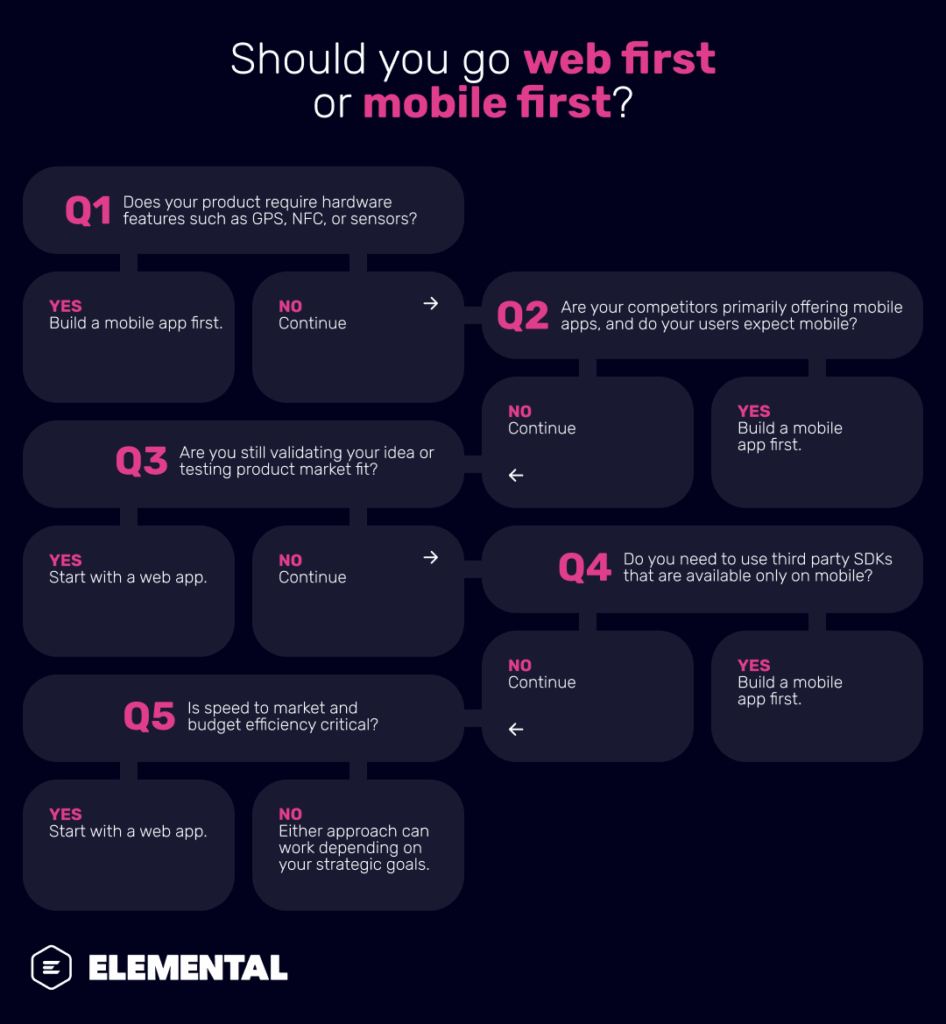
A Practical Way to Decide, Web or Mobile First
Below is a simple decision flow to guide your thinking. You can translate this into a visual diagram for publication.
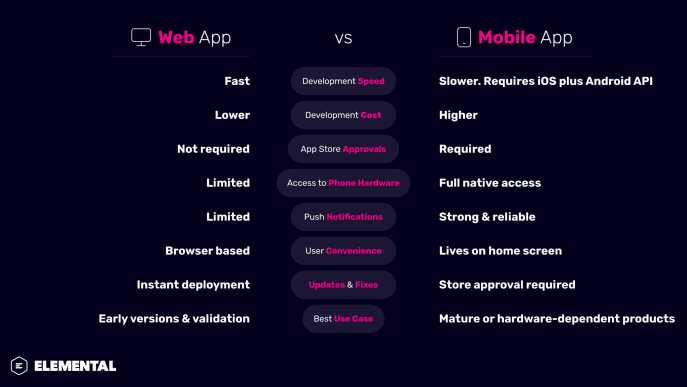
Comparison Table, Web App vs Mobile App
Final Thoughts
Choosing between a web app and a mobile app as your first release depends on your goals, your users, and the functionality you require. In many cases, starting with a web app allows teams to move faster, manage their costs, and learn what their users truly need before investing in mobile development. In other situations, mobile is clearly the right choice from day one. There is no single rule that fits every product, which is why evaluating the trade offs early on can set your project up for long term success.
Written by Angelo Zanetti, co-founder and CEO of Elemental, a South African web and software development company.


